 vi
vi Popular
 29-Apr-2026
 1,003
1,003 

Table of content
1.Nutrition for chickens, a crucial factor in determining farming performance
In modern poultry farming, chicken nutrition not only affects growth rate but also directly determines survival rate, production costs, and farmer profits.
A proper chicken nutrition program will help:
- Increase weight gain
- Shorten rearing time
- Reduce feed conversion ratio (FCR)
- Improve meat quality
In practice, large-scale farming models show that when the right nutritional solutions are applied, the results achieved are significantly better than traditional farming methods.
2.Actual poultry farming performance: The effectiveness of a chicken nutrition program
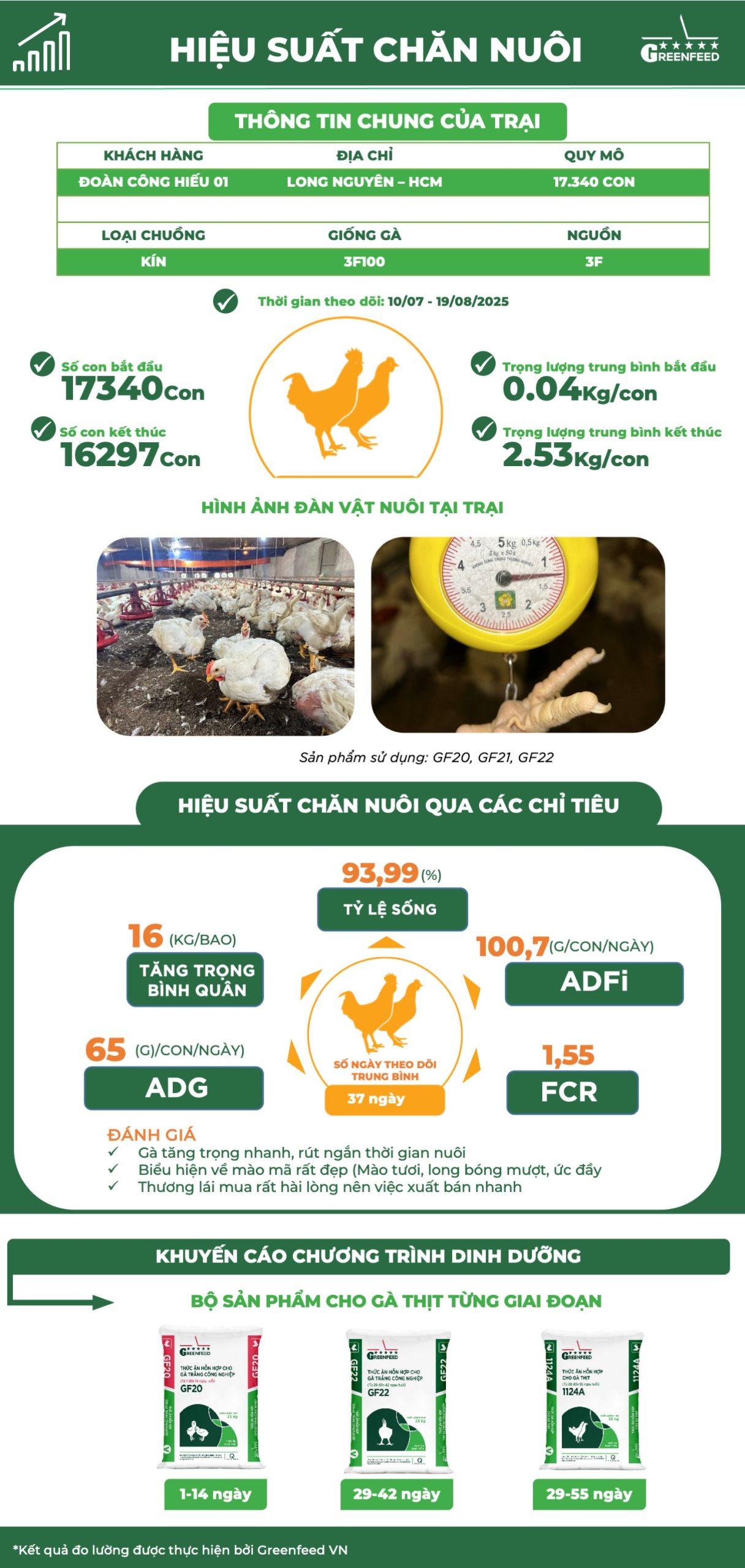
At Mr. Doan Cong Hieu’s chicken farm, which has a scale of 17,340 broiler chickens, a nutritional program for chickens is applied according to each stage of development. The results recorded after 37 days with the products used are as follows:GF20, GF21, GF22
Key Indicators:
- Survival Rate: 93.99%
- Average Weight: 2.53 kg/chicken
- ADG (Average Daily Gain): 65g/chicken/day
- ADFi (Advantaged Daily Feed Consumption): 100.7g/chicken/day
- FCR: 1.55
These are very good indicators in broiler chicken farming, showing that the chicken nutrition program is effectively optimized.
3. Why is nutrition crucial for chickens’ success?
1.Direct impact on weight gain
Chickens provided with adequate nutrition will:
- Grow faster
- Grow more uniformly
- Have less loss
In practical results, chickens gained from 0.04kg to 2.53kg in just 37 days, showing a clear effect from the nutritional regime.
2.Optimize the Feed Conversion Ratio (FCR)
FCR = 1.55 means that only 1.55kg of feed is needed to produce 1kg of chicken weight. This is a good FCR, which helps:
- Reduce feed costs
- Increase profits
- Improve survival rate
3.A survival rate of nearly 94% shows:
- Healthy chickens
- Less disease
- Good immune system
This depends greatly on the quality of nutrition for chickens.
4. Chicken nutrition program by stage
For optimal results, chicken nutrition should be divided into stages:
Stage 1: Chicks (1–14 days), GF20 product
- Easily digestible feed
- Rich in protein
- Enzyme supplementation
Helps chickens develop their digestive and immune systems
Stage 2: Growing chickens (15–28 days), GF21 product
- Increased energy
- Nutrition balance
Optimized weight gain rate
Stage 3: Finishing chickens (29–42+ days), GF22 product
- Focus on weight gain
- Optimized meat yield
Shortened time to market
5. Signs of effective chicken nutrition
From practical experience, chickens with good nutrition will have:
- Smooth, shiny feathers
- Bright red comb
- Active movements
- Fast weight gain
- Uniformity flock
These are important indicators for evaluating the effectiveness of chicken nutrition in practice.
6. Common mistakes in chicken nutrition
Many poultry farmers fail to optimize efficiency due to:
- Using one type of feed for all stages
- Not controlling feed rations
- Lack of nutritional balance
- Abuse of antibiotics
These mistakes lead to:
- Slow growth
- High FCR (Feed Conversion Ratio)
- Increased costs
7. Solutions for optimizing chicken nutrition
To achieve the efficiency of real-world models, it is necessary to:
✔️ Choose feed according to each stage
✔️ Ensure a reasonable ration
✔️ Combine enzymes & probiotics
✔️ Manage the rearing environment well
✔️ Monitor growth regularly
Benefits of Investing in the Right Chicken Nutrition
An optimal chicken nutrition program brings:
- Faster growth
- Reduced feed costs
- Increased survival rate
- Improved meat quality
- Maximizing profits
Conclusion
In modern poultry farming, nutrition Feeding chickens is no longer a secondary factor but a key “profit lever”.
In reality, large-scale models show that:
When the right nutrition program is applied, chickens can reach a weight of over 2.5kg in just over a month, with optimal FCR and a high survival rate.
Therefore, investing in quality and appropriate nutrition for each stage of chicken growth is the key to sustainable development and increased economic efficiency for poultry farmers.


 23-Sep-2026